


Philippines
Island days, built your way
Choose an island cluster well, then make room for limestone lagoons, surf towns, waterfalls and the famously social backpacker circuit.
Vyacheslav Argenberg / Wikimedia Commons, CC BY 4.0 · Image licence
The honest overview
Get to know Philippines before fixing the route.
The Philippines is famed for its dive-clear lagoons, thousands of undeveloped islands and some of the warmest hospitality in Southeast Asia, attracting divers, island-hoppers and long-term backpackers alike from across the region and beyond. The Philippines is known for being an archipelago where the standard backpacker circuit sits well clear of the areas the Foreign, Commonwealth & Development Office (FCDO) advises against, thanks to a regional advisory covering western and central Mindanao and the Sulu archipelago – with the rest of Mindanao rated essential-travel-only outside a handful of named exceptions – that simply doesn't overlap with the Luzon–Palawan–Visayas route most travellers follow, making this one of Southeast Asia's more popular backpacking countries despite carrying a country-wide advisory flag.
Part of the joy of backpacking in Philippines is deciding what deserves more time. Keep space for weather changes, longer travel days and recommendations from people you meet on the road.
Carry cash outside Manila, Cebu City and the bigger malls – card acceptance thins out fast on the islands, and where it exists it often comes with a surcharge.
Given how spread out the islands are, there isn't one fixed Philippines route – most backpackers build a flexible plan around domestic flights rather than one continuous overland trail, and change plans as they pick up travel companions along the way. A common shape starts in Manila, loops north through Banaue and Batad for the rice terraces and down through Baguio, then flies south to Palawan for El Nido and Coron before island-hopping onward to Cebu, Bohol and Boracay in the Visayas. Siargao, in the far south, is a popular final stop for surfers – worth flagging that although it sits within the Mindanao island group, the FCDO's advisory doesn't extend to Siargao itself, which carries no elevated advice unlike much of the rest of the island. None of the standard routes run through western or central Mindanao or the Sulu archipelago, which the FCDO advises against travelling to entirely.
Season by season
What each season means for your trip
Philippines's weather can change sharply by region and elevation. These are planning patterns, not guarantees.
Drier travel window
Cool dry season, 24–30°C, with the lowest humidity and lowest typhoon risk of the year. Peak tourist season across the islands, especially Boracay, El Nido and Siargao.
Drier travel window
Hot and dry, 28–36°C, the hottest stretch of the year. Holy Week (Semana Santa, dates shift) sees a spike in domestic travel as Filipinos head home or to the beach for the long weekend, so book island transport ahead if your dates overlap.
Wetter travel conditions
The southwest monsoon (habagat) arrives, 26–32°C with regular afternoon downpours. Typhoon season begins, more likely to disrupt Luzon and the northern Visayas than the south.
Seasonal conditions
Peak typhoon season, 26–31°C, with the heaviest storm activity and the highest chance of ferry and flight disruption, particularly on the eastern seaboard. Mindanao sits mostly outside the typhoon belt, one reason Siargao's surf season runs later into the year than most Southeast Asian coasts.
Check the forecast for the exact region and elevation on your route, then leave room to change outdoor plans when conditions move.
Cost of day to day travel
Build a budget around the route
Costs vary more by island than by country here, but this isn't a bargain-basement Southeast Asian budget destination the way Thailand or Vietnam can be.
Costs vary more by island than by country here, but this isn't a bargain-basement Southeast Asian budget destination the way Thailand or Vietnam can be.
Long transfers, specialist tours and headline activities can change the daily total quickly.
Carry cash outside Manila, Cebu City and the bigger malls – card acceptance thins out fast on the islands, and where it exists it often comes with a surcharge.
Average the full trip rather than forcing every day into the same number. Keep emergency funds separate from daily spending.
Key backpacker routes
Find the route that feels right for you
There is no single route you need to follow. Let your timeframe, interests and season shape the journey through Philippines.
Start with the natural route Core journey
Given how spread out the islands are, there isn't one fixed Philippines route – most backpackers build a flexible plan around domestic flights rather than one continuous overland trail, and change plans as they pick up travel companions along the way. A common shape starts in Manila, loops north through Banaue and Batad for the rice terraces and down through Baguio, then flies south to Palawan for El Nido and Coron before island-hopping onward to Cebu, Bohol and Boracay in the Visayas.
Add the region that earns your time Build depth
Siargao, in the far south, is a popular final stop for surfers – worth flagging that although it sits within the Mindanao island group, the FCDO's advisory doesn't extend to Siargao itself, which carries no elevated advice unlike much of the rest of the island. None of the standard routes run through western or central Mindanao or the Sulu archipelago, which the FCDO advises against travelling to entirely.
Main destinations and attractions
Where to spend your days
Pick a connected group and leave room for hostel friendships and changing plans. Philippines rewards depth more than a checklist of stops.
 Manila. Photo: express000 / flickr, BY-NC-SA 2.0.
Manila
The gateway city and most people's first stop, dense, hot and a little chaotic. Intramuros, the old Spanish walled city, and Rizal Park are the main historical draws, and Binondo claims to be the world's oldest Chinatown.
 Banaue and Batad, North Luzon. Photo: ~MVI~ (warped) / flickr, BY 2.0.
Banaue and Batad, North Luzon
Home to the UNESCO-listed rice terraces carved into the Cordillera mountains over 2,000 years ago. Batad in particular requires a hike in, which keeps it quieter than Banaue's more accessible viewpoints. Homestays are the norm here rather than hostels.
 Baguio. Photo: FotoGrazio / flickr, BY-NC-ND 2.0.
Baguio
Known as the "Summer Capital" for its cooler mountain climate, a welcome break from the heat lower down.
 El Nido and Coron, Palawan. Photo: Storm Crypt / flickr, BY-NC-ND 2.0.
El Nido and Coron, Palawan
Dramatic limestone lagoons, hidden beaches and some of the best island-hopping in the country, done via the standardised "Tour A–D" boat routes out of El Nido.
 Cebu City and Moalboal. Photo: α is for äpΩL † / flickr, BY-NC-ND 2.0.
Cebu City and Moalboal
Cebu City is the main hub for the central Visayas, with Magellan's Cross and the Basilica del Santo Niño as the historical anchors.
 Bohol and Panglao. Photo: Lost In The RP / flickr, BY 2.0.
Bohol and Panglao
The Chocolate Hills are the headline attraction, alongside the Philippine tarsier sanctuary (stick to the accredited one, not the roadside photo-op stalls).
The Philippines' islands cover a lot of ground, but here's a shape of it by region:
Getting around
Compare time, comfort and cost
Getting around the Philippines means thinking in flights and ferries rather than one continuous overland route – it's an archipelago of over 7,000 islands, and long bus journeys between regions usually aren't an option.
Taxi/Rideshare
Grab operates in Manila, Cebu and most bigger cities and is the easiest way to skip haggling with a metered taxi.
Bus
Air-conditioned coaches (Victory Liner and others) connect major Luzon cities cheaply, with overnight options on longer routes. There's no equivalent overland network once you're inter-island.
Plane
Domestic flights (Cebu Pacific, Philippine Airlines, AirAsia Philippines) are how most backpackers get around – short hops between Manila, Cebu, Palawan and Siargao are often cheaper and always faster than the ferry equivalent, though delays and cancellations are common in typhoon season.
Ferry
Inter-island ferries (2GO Travel for longer overnight routes, OceanJet and similar operators for shorter fast-craft hops) connect the archipelago where flights don't, but schedules get cancelled at short notice in rough weather – build a spare day either side of any ferry-dependent leg.
Download offline maps, keep key booking details available without data and avoid placing an international departure immediately after a fragile overland transfer.
eSIMs (Globe, Smart) are easy to set up before you land, and it's worth downloading offline maps for any island where signal drops out between towns.
Culture and events
Events worth knowing about
Dates can shift, so verify the current programme before building a trip around an event in Philippines.
A religious festival honouring the Santo Niño, with elaborate street parades, drumming and dancing that draw well over a million visitors into Cebu City for the weekend.
A flower festival marking the city's recovery from the 1990 earthquake, built around flower-covered floats and street dancing competitions along Session Road.
A harvest festival where entire house façades are decorated with rice wafers, fruit and vegetables in bright displays, judged street by street.
A cultural festival built around smiling, brightly painted masks and street dancing, created in the 1980s to lift the city's spirits during an economic downturn.
Confirm the official programme, accommodation pressure and transport changes before committing non-refundable plans.
Filipino food
Discover the flavours that make Philippines memorable
Filipino food doesn't get the same global spotlight as its Southeast Asian neighbours, but it's worth building meals around – expect sour, salty and sweet flavours often in the same dish, with real Spanish and Chinese influence layered over local cooking.
-
 Adobothe closest thing to a national dish, meat braised in vinegar, soy sauce, garlic and bay leaf; every region and household has its own version.Photo: ~MVI~ (warped) / flickr, BY 2.0
 -
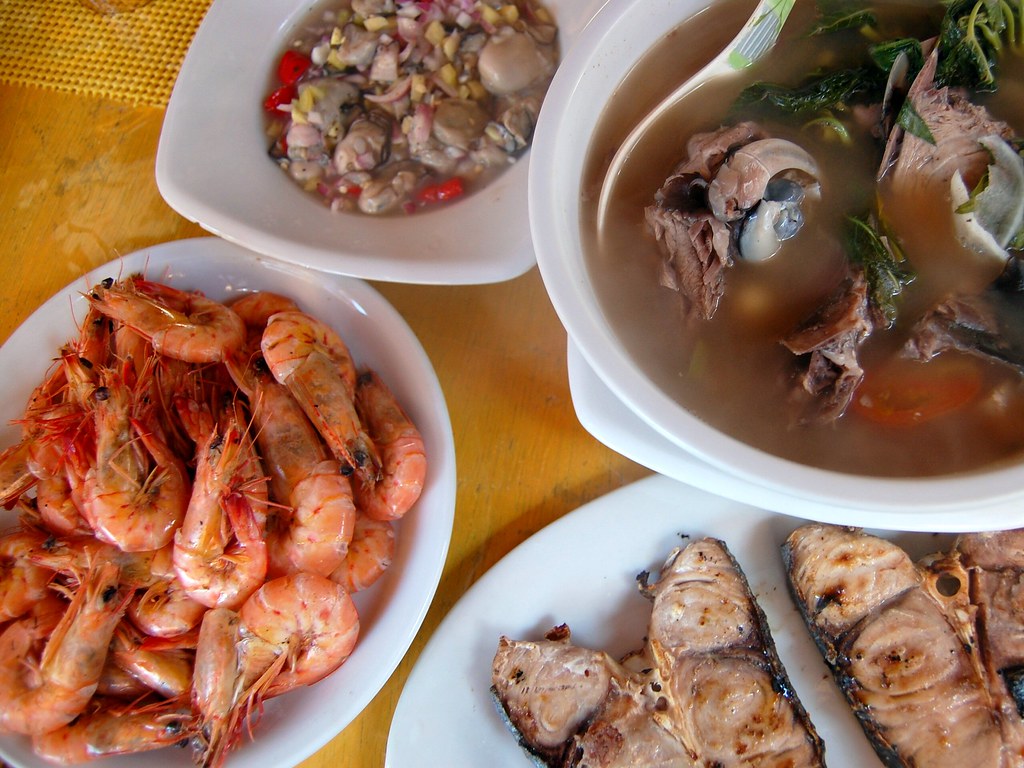 Siniganga sour tamarind-based soup, usually with pork or fish, built around whatever vegetables are in season.Photo: ~MVI~ (warped) / flickr, BY 2.0
 -
 Lechonwhole roast pig, crackling skin and all; Cebu's version is famous nationwide, worth trying at Zubuchon.Photo: lemuelinchrist / flickr, BY 2.0
 -
 Sisigsizzling chopped pork face and liver, seasoned with calamansi and chilli, said to have originated in Angeles City.Photo: ~MVI~ (warped) / flickr, BY 2.0
 -
 Halo-haloa shaved-ice dessert piled with sweet beans, jelly, fruit and leche flan, mixed together before eating.Photo: Judgefloro / wikimedia, CC0 1.0
 -
 Pancitstir-fried noodles with vegetables and meat, served at almost every celebration.Photo: ~MVI~ (warped) / flickr, BY 2.0
 -
 Lumpiafried spring rolls, found on every street corner and market stall.Photo: FotoGrazio / flickr, BY-NC-ND 2.0
 -
 Kare-karean oxtail and vegetable stew in a rich peanut sauce, usually served with shrimp paste on the side.Photo: dbgg1979 / flickr, BY 2.0
Visible turnover is a useful guide. Explain allergies carefully and carry a translated note when an ingredient could cause a serious reaction.
Public markets and turo-turo (point-point) eateries are the fastest way to work through a lot of this in one sitting, and nearly every town has one.
Hostels
Choose the atmosphere, not just the bed
Hostels cluster around the main backpacker stops – Manila, Cebu, Bohol, Boracay, El Nido and Siargao – and thin out fast anywhere off that route.
Frendz Hostel El Nido
El Nido, PhilippinesProperty image from Hostelworld's official HOSCAR record.View photos and details →Manila-Z-Hostel
Manila, PhilippinesProperty image from Hostelworld's official HOSCAR record.View photos and details →Sunlit Hostel
Siargao Island, PhilippinesProperty image from Hostelworld's official HOSCAR record.View photos and details →Lub d Manila Makati
Manila, PhilippinesProperty image from Hostelworld's official HOSCAR record.View photos and details →Bohol Coco Farm
Panglao Island, PhilippinesProperty image from Hostelworld's official HOSCAR record.View photos and details →Outpost Hostel
Coron, PhilippinesProperty image from Hostelworld's official HOSCAR record.View photos and details →What you need to pack
Pack for the route, not every possibility
The gear you need depends on when and where in the islands you're headed, so check out our trip planner for a kit list built around your exact dates and route.
Climate and clothing
The main challenge here is heat and humidity punctuated by sudden, heavy downpours, especially outside the December–February dry window – pack breathable, quick-dry clothing and a light rain shell you can throw on without warning.
- A dry bag – essential for island-hopping boats and ferry crossings, keeps your phone and passport safe from spray and the occasional soaking.
- Padlocks – for securing bags and hostel lockers.
Rain and terrain
Choose footwear and weather protection for the terrain and season on your route.
- Reef-safe sunscreen – some marine parks, including areas around El Nido, restrict or discourage non-reef-safe sunscreen; worth packing the right kind before you land rather than hunting for it on a small island.
- A basic first aid kit – plasters, rehydration sachets, an antidiarrhoeal and something for an upset stomach.
Hostels and travel days
Hostels and local laundrettes both offer cheap, quick turnarounds, so you can pack light either way.
- DEET mosquito spray – dengue is present year-round, so this matters more here than in a lot of Southeast Asia.
- A reusable water bottle with a filter – tap water isn't reliably drinkable here, and this cuts down on buying plastic bottles island to island.
Activities and health
Add specialist equipment only for booked activities and current health guidance.
- A universal travel adapter and a power bank – the Philippines runs on Type A/B sockets at 220V.
- Run all of this through the trip planner to build a kit list based on your specific route and dates.
Language
A few local phrases go a long way
English is an official language alongside Filipino and is spoken to a high standard almost everywhere backpackers go, so this list covers courtesy and connection more than necessity – locals will notice and appreciate the effort even though you won't strictly need it to get by.
Filipino (Tagalog)
| English | Say it in Filipino (Tagalog) | Pronunciation |
|---|---|---|
| Hello | Kumusta | koo-moose-tah |
| Goodbye | Paalam | pah-ah-lahm |
| Yes / No | Oo (oh-oh) / Hindi | hin-dee |
| How much? | Magkano? | mag-kah-no |
| How are you? | Kumusta ka? | koo-moose-tah kah |
| Please | Paki- (pah-kee), added as a prefix to a request rather than a standalone word | Check locally |
| Do you speak English? | Marunong ka ba mag-Ingles? | mah-roo-nong kah bah mahg-in-glehs |
| Help, please | Tulong po | too-long poh |
| Where are you from? | Taga-saan ka? | tah-gah-sah-ahn kah |
| What is your name? / My name is... | Ano ang pangalan mo? / Ang pangalan ko ay... | ah-noh ang pah-ngah-lahn moh / ang pah-ngah-lahn koh eye |
| Thank you | Salamat | sah-lah-mat |
Use these phrases respectfully and let a translation app handle detailed or important questions.
Visa requirements
Check the rule for your passport
Entry rules depend on nationality, journey and length of stay. Confirm the current rule before booking, then check it again shortly before departure.
Check your exact requirements
Use Sherpa to review entry requirements for your passport and journey. Also confirm passport validity, permitted stay, proof of onward travel and any current arrival-form requirements.
Vaccinations
Make the advice fit your route
Vaccination and health advice depends on your route, duration, medical history and activities.
Review current CDC guidance
Read the current CDC Philippines traveller guidance, then discuss personal recommendations with a qualified clinician.
Arrange appropriate travel insurance and keep policy details available offline. Consider the practical risks created by climate, altitude, insects, animals, water activities and road travel on your specific route.
Safety and common scams
Standard caution, specific habits
The FCDO currently advises against all travel to western and central Mindanao and the Sulu archipelago, and against all but essential travel to the rest of Mindanao outside Camiguin, Dinagat and Siargao, due to the risk of terrorism, armed clashes and kidnapping in the south of the country.
Tricycle and taxi overcharging
especially around airports and ferry terminals, drivers may quote a flat fare well above the going rate for tourists. Ask your hostel what a fair price looks like before you arrive, or use Grab where it's available.
Unofficial tour touts at ports and piers
people selling island-hopping trips outside the official booking booths sometimes take payment for tours that don't exist or add on undisclosed fees once you're on the water. Book through your hostel or an official counter.
Fake or corrupt police checks
rare but documented, occasionally reported around nightlife areas. If stopped, ask to see ID and insist on going to a proper station rather than settling anything on the spot.
Money-changer short-changing
count your cash before walking away from informal money changers, particularly in tourist-heavy areas.
Bag snatching in crowded transport
jeepneys and public markets are the usual spots; keep bags zipped and in front of you.
None of it should put you off
millions of backpackers pass through the Philippines every year without incident. Just keep an eye on the current advisory status if your plans stretch further south than Siargao.
Within the areas backpackers visit day to day, the risks are the usual overtourism-adjacent ones rather than anything specific to the advisory:
Sources and feedback
Help us keep this guide useful
Travel information changes. Verify current entry, health, safety and transport guidance before booking or travelling.
If you spot anything that could be improved, corrected or updated, please use our contact page or email hello@outpacker.co.uk.
If any information is outdated or incorrect, Outpacker assumes no liability.