


Galapagos
The Enchanted Isles
Plan a wildlife-first island journey where volcanic landscapes, marine encounters and conservation rules shape every day.
Ndecam from London, UK / Wikimedia Commons, CC BY 2.0 · Image licence
The honest overview
Get to know Galapagos before fixing the route.
Known as the Enchanted Isles, the Galápagos Islands are famed for wildlife found nowhere else on Earth, otherworldly volcanic landscapes and some of the best snorkelling and diving on the planet, attracting nature lovers, divers and long-haul South America backpackers alike from every corner of the world. The Galápagos are known for being one of the most expensive stops on a South America itinerary, thanks to mandatory park fees, limited inter-island transport and food and goods shipped in from the mainland, making this a splurge most backpackers plan for and save towards rather than a place that fits a typical shoestring budget.
Part of the joy of backpacking in Galapagos is deciding what deserves more time. Keep space for weather changes, longer travel days and recommendations from people you meet on the road.
On top of daily spend, every visitor pays a one-off Galápagos National Park entry fee of $200 (about £155) in cash on arrival, plus a $20 (about £16) Transit Control Card bought before departure from mainland Ecuador. Budget for these separately from your daily figure, since they land as a single hit at the start of the trip rather than a spread-out cost. Multi-day cruises, the more traditional way to see the outer, uninhabited islands, run substantially higher again, often £250–500+ a day, and sit outside independent backpacker budgets entirely.
There's no single backpacker trail through the Galápagos in the way there is through Southeast Asia, since almost all movement happens by air into one hub island and by boat between the others, rather than an overland route you can freestyle. Most independent trips fly into Baltra or San Cristóbal from Quito or Guayaquil, then base themselves in Puerto Ayora on Santa Cruz, the archipelago's main hub for hostels, tours and boat departures. From there, daily public speedboats (lanchas) run out to Isabela and San Cristóbal, and less frequently to Floreana, making a loop between three or four inhabited islands realistic on a one-to-two week trip. Worth knowing before you build an itinerary: the more remote, uninhabited islands (Bartolomé, Genovesa, Fernandina and others) have no independent access at all and are only reachable on a multi-day cruise, so a land-based budget trip will miss them entirely.
Season by season
What each season means for your trip
Galapagos's weather can change sharply by region and elevation. These are planning patterns, not guarantees.
Wetter travel conditions
Warm and increasingly wet, with air temperatures of 24–29°C and water warm enough for comfortable snorkelling without a wetsuit. Seas are at their calmest, underwater visibility improves through the period, and giant tortoises begin nesting.
Wetter travel conditions
The warmest, wettest stretch of the year, with 26–30°C days and short, heavy tropical showers most afternoons. Considered the sweet spot by many repeat visitors: calm seas, warm water and peak frigatebird and land iguana courtship displays.
Wetter travel conditions
The garúa (mist) season sets in, with cooler air of 20–24°C, a persistent low cloud that blankets the highlands, and choppier seas as the cold Humboldt Current strengthens. Water temperatures drop noticeably, so a wetsuit is worth having for snorkelling. This is also peak season for waved albatross arriving on Española.
Seasonal conditions
The coolest, greyest months, with 17–22°C days, the roughest seas of the year and the fewest tourists. Blue-footed booby courtship displays peak here, and land-based wildlife viewing (as opposed to underwater) is arguably at its best, even if the weather itself is the least appealing of the year.
Check the forecast for the exact region and elevation on your route, then leave room to change outdoor plans when conditions move.
Cost of day to day travel
Build a budget around the route
Independent, land-based travel through the Galápagos runs to roughly £70–110 a day, covering a guesthouse or hostel bed, meals, inter-island boat transfers and one modest day tour.
Independent, land-based travel through the Galápagos runs to roughly £70–110 a day, covering a guesthouse or hostel bed, meals, inter-island boat transfers and one modest day tour.
Long transfers, specialist tours and headline activities can change the daily total quickly.
On top of daily spend, every visitor pays a one-off Galápagos National Park entry fee of $200 (about £155) in cash on arrival, plus a $20 (about £16) Transit Control Card bought before departure from mainland Ecuador.
Average the full trip rather than forcing every day into the same number. Keep emergency funds separate from daily spending.
Key backpacker routes
Find the route that feels right for you
There is no single route you need to follow. Let your timeframe, interests and season shape the journey through Galapagos.
Start with the natural route Core journey
There's no single backpacker trail through the Galápagos in the way there is through Southeast Asia, since almost all movement happens by air into one hub island and by boat between the others, rather than an overland route you can freestyle. Most independent trips fly into Baltra or San Cristóbal from Quito or Guayaquil, then base themselves in Puerto Ayora on Santa Cruz, the archipelago's main hub for hostels, tours and boat departures.
Add the region that earns your time Build depth
From there, daily public speedboats (lanchas) run out to Isabela and San Cristóbal, and less frequently to Floreana, making a loop between three or four inhabited islands realistic on a one-to-two week trip. Worth knowing before you build an itinerary: the more remote, uninhabited islands (Bartolomé, Genovesa, Fernandina and others) have no independent access at all and are only reachable on a multi-day cruise, so a land-based budget trip will miss them entirely.
Main destinations and attractions
Where to spend your days
Pick a connected group and leave room for hostel friendships and changing plans. Galapagos rewards depth more than a checklist of stops.
 Santa Cruz. Photo: Dallas Krentzel / flickr, BY 2.0.
Santa Cruz
The main hub and most developed island, home to Puerto Ayora, the archipelago's largest town. The Charles Darwin Research Station is the easiest place to see giant tortoises and learn the conservation backstory, Tortuga Bay is a short walk or bike ride to a stretch of white-sand beach that lives up to the hype, and the highlands hold wild tortoise reserves worth a half-day trip.
 Isabela. Photo: NASA's Marshall Space Flight Center / nasa, BY-NC 2.0.
Isabela
The largest island by landmass and a quieter, more laid-back base than Santa Cruz. Puerto Villamil is the only town, Los Túneles is one of the best snorkelling sites in the archipelago (sea turtles, rays and reef sharks are common), and Sierra Negra volcano offers one of the more accessible multi-hour hikes in the islands, with one of the largest volcanic calderas on Earth.
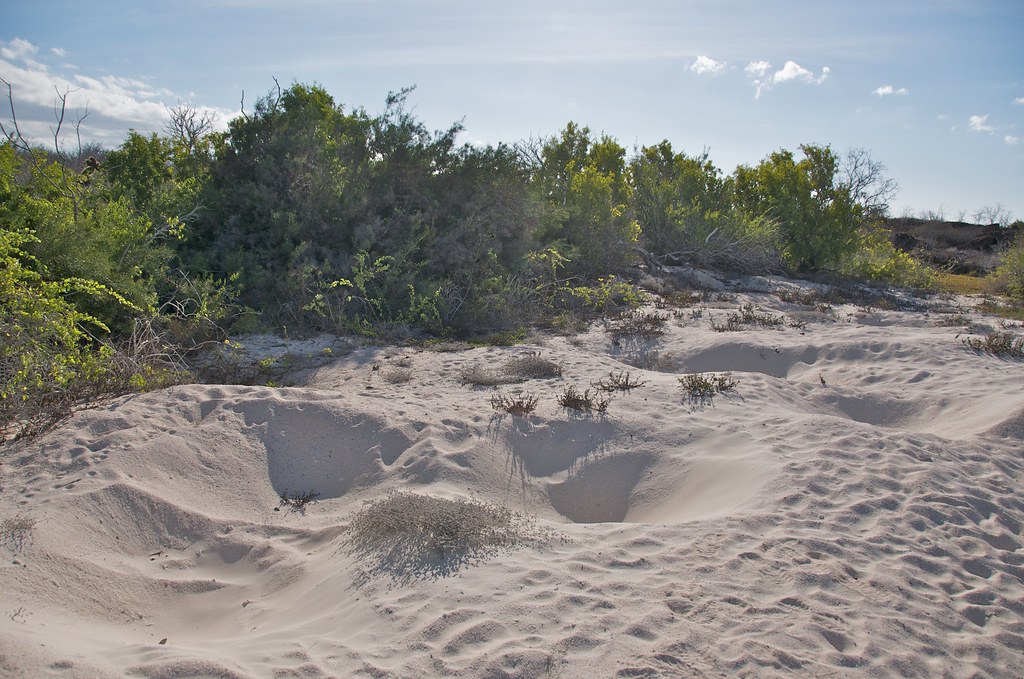 San Cristóbal. Photo: A.Davey / flickr, BY 2.0.
San Cristóbal
Home to Puerto Baquerizo Moreno, the archipelago's administrative capital and a solid alternative arrival point to Santa Cruz.
 Floreana. Photo: Dallas Krentzel / flickr, BY 2.0.
Floreana
The least-visited inhabited island, reachable by day boat from Santa Cruz rather than an overnight stay for most independent travellers.
The Galápagos are spread across several inhabited islands, each reachable independently, plus a set of uninhabited islands that aren't – worth reading this alongside the Routes section above before planning your stops. To get a feel for the islands beyond a guide-led tour, ask at your hostel about self-guided options at the free, accessible sites like Tortuga Bay or Concha Perla, since not every site requires a licensed guide. Our Outpacker chatbot is available to help you plan and build out your itinerary to make the most of your trip.
Getting around
Compare time, comfort and cost
There's no overland transport network here in the conventional sense, since the islands are separated by open ocean and infrastructure is deliberately limited to protect the ecosystem – flights and boats do almost all the work.
Plane
Domestic flights connect Quito and Guayaquil to Baltra (for Santa Cruz) or San Cristóbal, run by Avianca, LATAM and EquAir.
Inter-island boat (lancha)
Speedboats run daily between Santa Cruz, Isabela and San Cristóbal, with less frequent departures to Floreana.
Taxi/truck
Puerto Ayora and the other port towns run on white pickup-truck taxis rather than conventional cars, cheap and easy to flag down for short hops or highland day trips.
Bike
A popular, free way to reach Tortuga Bay from Puerto Ayora, with hire shops near the harbour.
Download offline maps, keep key booking details available without data and avoid placing an international departure immediately after a fragile overland transfer.
Culture and events
Events worth knowing about
The Galápagos are a young, sparsely populated territory rather than a place with a deep annual festival calendar, and there's very little here in the way of major cultural events aimed at visitors.
A civic anniversary marking the 1832 annexation of the islands by Ecuador, marked with small local parades and events in Puerto Ayora and Puerto Baquerizo Moreno rather than anything visitor-oriented.
Confirm the official programme, accommodation pressure and transport changes before committing non-refundable plans.
Galapagos food
Discover the flavours that make Galapagos memorable
Food in the Galápagos leans heavily on the surrounding ocean, and while it's not a food-tourism destination the way mainland Ecuador can be, fresh seafood here is excellent.
-
 Cevicheraw fish or shrimp cured in citrus, the dish that shows up on nearly every menu.Photo: Rinaldo Wurglitsch / flickr, BY 2.0
 -
 Encebolladoa tuna and cassava soup with pickled red onion, a local staple rather than a tourist dish.Photo: Mark & Andrea Busse / flickr, BY-NC-ND 2.0
 -
 LangostinoGalápagos spiny lobster, in season roughly September to December and worth seeking out fresh.Photo: Rinaldo Wurglitsch / flickr, BY 2.0
 -
 Pataconestwice-fried plantain, the standard side with almost any seafood plate.Photo: Rinaldo Wurglitsch / flickr, BY 2.0
 -
 Empanadas de verdegreen plantain empanadas, usually filled with cheese.Photo: Me-Liss-A / flickr, BY 2.0
Visible turnover is a useful guide. Explain allergies carefully and carry a translated note when an ingredient could cause a serious reaction.
Hostels
Choose the atmosphere, not just the bed
Hostels here are smaller and simpler than the big Southeast Asia-style chains, and what you pick mostly comes down to which island you're basing yourself on.
Hostal Galapagos by Bar de Beto
Puerto Villamil, Isabela Island, GalapagosA family-run stay close to Puerto Villamil's main beach and flamingo lagoon, with a shared kitchen and beach-bar common area. Compare recent reviews and current facilities before booking.
Property image from the linked Hostelworld listing.View photos and details →Hostal Vista al Mar
Puerto Ayora, Santa Cruz Island, GalapagosA central Puerto Ayora base near the passenger pier, shops and restaurants, with a shared kitchen and garden. Compare current room types, atmosphere and recent reviews before booking.
Property image from the linked Hostelworld listing.View photos and details →Hostal Gardner
Puerto Ayora, Santa Cruz Island, GalapagosA small central option in Puerto Ayora with shared facilities and an outdoor terrace. Confirm reception hours, payment terms and current reviews before booking.
Property image from the linked Hostelworld listing.View photos and details →Hostal Puerto Ayora
Puerto Ayora, Santa Cruz Island, GalapagosA family-run central stay close to banks, restaurants, travel agencies and the route to Tortuga Bay. Check current availability, facilities and recent reviews before booking.
Property image from the linked Hostelworld listing.View photos and details →What you need to pack
Pack for the route, not every possibility
The gear you need depends on the time of year and wider countries you plan to visit, so check out our trip planner for anything specific to your dates and countries – it'll build you a kit list based on exactly where and when you're going.
Climate and clothing
The main challenge here is sun and water exposure rather than heat itself, since sitting on the equator means UV is intense even on overcast garúa days.
- Reef-safe, mineral-based sunscreen – standard chemical sunscreens are discouraged around the marine reserve, and some tour operators won't let you in the water without a reef-safe formula.
- A universal travel adapter and a power bank – Ecuador runs on Type A/B sockets at 120V.
- One more to flag: park rules require staying at least two metres from wildlife at all times and sticking to marked trails, so leave the selfie stick at home and budget more time than you'd expect for slow, patient wildlife encounters instead.
Rain and terrain
Choose footwear and weather protection for the terrain and season on your route.
- A dry bag – for the inter-island lancha crossings, which throw up spray even on calm days.
- A reusable water bottle – tap water isn't drinkable here, and bottled water adds up fast on an already expensive trip.
Hostels and travel days
Laundry is available in the main port towns but at a premium compared with mainland Ecuador, so pack slightly lighter on quick-dry basics than you might elsewhere and do washes more often rather than carrying a full week's worth.
- Anti-seasickness tablets or wristbands – the boat crossings between islands can get choppy, especially June to November.
- A basic first aid kit – plasters, rehydration sachets and something for an upset stomach, since pharmacies are limited outside Puerto Ayora and Puerto Baquerizo Moreno.
Activities and health
Add specialist equipment only for booked activities and current health guidance.
- A light fleece or windproof layer – for cooler garúa-season mornings and evenings, June to November.
- Run all of this through the trip planner to build your full kit based on your specific route and dates.
Language
A few Spanish phrases go a long way
Spanish is the official language across the islands, and while tour guides and hostel staff in Puerto Ayora and the other port towns generally speak workable English, it thins out fast once you're off the main tourist strip.
| English | Say it in Spanish | Pronunciation |
|---|---|---|
| Hello | Hola | oh-lah |
| Goodbye | Adiós | ah-dee-ohs |
| Yes / No | Sí (see) / No | noh |
| How much? | ¿Cuánto cuesta? | kwan-toh kwes-tah |
| How are you? | ¿Cómo estás? | koh-moh es-tahs |
| Please | Por favor | pohr fah-vohr |
| Do you speak English? | ¿Hablas inglés? | ah-blahs een-glehs |
| Help, please | Ayuda, por favor | ah-yoo-dah pohr fah-vohr |
| Where are you from? | ¿De dónde eres? | deh dohn-deh eh-rehs |
| What is your name? / My name is... | ¿Cómo te llamas? / Me llamo... | koh-moh teh yah-mahs / meh yah-moh |
| Thank you | Gracias | grah-syahs |
| Use the phrases respectfully: Local usage varies by region. A respectful attempt is usually appreciated, and a translation app is useful for complex questions. | ||
Visa requirements
Check the rule for your passport
Entry rules depend on nationality, journey and length of stay. Confirm the current rule before booking, then check it again shortly before departure.
Check your exact requirements
Use Sherpa to review entry requirements for your passport and journey. Also confirm passport validity, permitted stay, proof of onward travel and any current arrival-form requirements.
Vaccinations
Make the advice fit your route
Vaccination and health advice depends on your route, duration, medical history and activities.
Review current CDC guidance
Read the current CDC Galapagos traveller guidance, then discuss personal recommendations with a qualified clinician.
Arrange appropriate travel insurance and keep policy details available offline. Consider the practical risks created by climate, altitude, insects, animals, water activities and road travel on your specific route.
Safety and common scams
Standard caution, specific habits
The Galápagos are low-hassle by South America standards, with a small, tourism-dependent population and none of the scam culture you'll find in bigger mainland hubs.
Beach and boat bag theft
Opportunistic theft from unattended bags on beaches or day-tour boats does happen occasionally. Keep valuables on you or locked in your accommodation rather than left with your towel.
Unlicensed or unauthorised guides
National park rules require a certified naturalist guide for most sites beyond the free-access spots (Tortuga Bay, Concha Perla, Frigatebird Hill). Book tours through your hostel or a visibly licensed operator in Puerto Ayora rather than someone approaching you on the street, since unauthorised operators can mean an invalid or turned-away booking on the day.
Wildlife-distance fines
Getting too close to wildlife for a photo is taken seriously here and can carry an on-the-spot fine from park rangers, not just a telling-off. Stick to the two-metre rule even when the animals themselves clearly don't care.
None of this should put you off the trip – this is one of the easier, safer places in South America to travel independently, the main friction is cost and logistics rather than personal safety.
Sources and feedback
Help us keep this guide useful
Travel information changes. Verify current entry, health, safety and transport guidance before booking or travelling.
If you spot anything that could be improved, corrected or updated, please use our contact page or email hello@outpacker.co.uk.
If any information is outdated or incorrect, Outpacker assumes no liability.