


Laos
River days and mountain roads
Slow down for Mekong journeys, limestone valleys, temple towns and northern routes where the journey is part of the experience.
Basile Morin / Wikimedia Commons, CC BY-SA 4.0 · Image licence
The honest overview
Get to know Laos before fixing the route.
Known as the Land of a Million Elephants, Laos is famed for its slow Mekong river life, French colonial towns and dramatic limestone mountains, attracting backpackers, slow travellers and nature lovers alike from across Southeast Asia and beyond. Laos is known for being a slower reset after Thailand or Vietnam, thanks to its quieter towns, rougher infrastructure and far fewer crowds, making it the palate cleanser most backpackers end up needing partway through a wider regional trip.
Part of the joy of backpacking in Laos is deciding what deserves more time. Keep space for weather changes, longer travel days and recommendations from people you meet on the road.
Cash is essential – ATMs run out or aren't available at all in smaller towns, and card acceptance is limited even in tourist hubs. Bring more USD or GBP to exchange than you think you'll need.
There's no one fixed route, but a few patterns come up a lot, most of them running roughly north to south. It helps to keep plans loose – you'll make friends in hostels along the way and end up shifting your route to travel with them, same as anywhere else in the region. Coming from Thailand, some cross at Huay Xai and take the two-day slow boat down the Mekong via Pakbeng into Luang Prabang – others give it a miss and just bus or fly straight in, especially if time's tight or the cramped seating puts them off. From there it's usually Vang Vieng and Vientiane, with Thakhek's motorbike loop or Pakse, the Bolaven Plateau and the 4000 Islands (Si Phan Don, often centred on Don Det) further south for those with more time. The new China-Laos railway has changed things too – Vientiane to Luang Prabang, which used to be an all-day bus, is now about two hours by train, so plenty skip the road trip on that leg. As with Thailand, most people are passing through as part of a wider Southeast Asia loop rather than treating Laos as a standalone trip.
Season by season
What each season means for your trip
Laos's weather can change sharply by region and elevation. These are planning patterns, not guarantees.
Drier travel window
The best weather of the year: dry, sunny and notably cooler than the rest of Southeast Asia, especially at night and up in the mountains around Luang Prabang and Phongsali, where it can drop into single digits. Days sit around 20–28°C. Peak tourist season.
Drier travel window
Hot and dry, climbing to 35–38°C by April. This is also burning season across the north (slash-and-burn farming), and the haze can be worse here than in northern Thailand – Luang Prabang and Vang Vieng skies often turn grey-brown for weeks. Pi Mai Lao (Lao New Year) hits mid-April with country-wide water fights.
Wetter travel conditions
Wet season, with the heaviest rain from July to September. Expect 27–32°C, high humidity and afternoon downpours that can wash out roads, especially in the south and along the Bolaven Plateau. River levels rise, which is actually good news for some waterfalls and cave trips (Kong Lor especially), less good news for slow boat schedules.
Check the forecast for the exact region and elevation on your route, then leave room to change outdoor plans when conditions move.
Cost of day to day travel
Build a budget around the route
Laos is cheap, arguably the cheapest country in mainland Southeast Asia day to day, though it doesn't always feel that way once you're there, since tourist infrastructure (hostels, cafés, guided activities) is thinner and prices in Luang Prabang and Vang Vieng have crept up.
Laos is cheap, arguably the cheapest country in mainland Southeast Asia day to day, though it doesn't always feel that way once you're there, since tourist infrastructure (hostels, cafés, guided activities) is thinner and prices in Luang Prabang and Vang Vieng have crept up.
Long transfers, specialist tours and headline activities can change the daily total quickly.
Cash is essential – ATMs run out or aren't available at all in smaller towns, and card acceptance is limited even in tourist hubs.
Average the full trip rather than forcing every day into the same number. Keep emergency funds separate from daily spending.
Key backpacker routes
Find the route that feels right for you
There is no single route you need to follow. Let your timeframe, interests and season shape the journey through Laos.
Start with the natural route Core journey
There's no one fixed route, but a few patterns come up a lot, most of them running roughly north to south. It helps to keep plans loose – you'll make friends in hostels along the way and end up shifting your route to travel with them, same as anywhere else in the region.
Add the region that earns your time Build depth
Coming from Thailand, some cross at Huay Xai and take the two-day slow boat down the Mekong via Pakbeng into Luang Prabang – others give it a miss and just bus or fly straight in, especially if time's tight or the cramped seating puts them off. From there it's usually Vang Vieng and Vientiane, with Thakhek's motorbike loop or Pakse, the Bolaven Plateau and the 4000 Islands (Si Phan Don, often centred on Don Det) further south for those with more time.
Keep the order flexible Adapt as you travel
The new China-Laos railway has changed things too – Vientiane to Luang Prabang, which used to be an all-day bus, is now about two hours by train, so plenty skip the road trip on that leg. As with Thailand, most people are passing through as part of a wider Southeast Asia loop rather than treating Laos as a standalone trip.
Main destinations and attractions
Where to spend your days
Pick a connected group and leave room for hostel friendships and changing plans. Laos rewards depth more than a checklist of stops.
 Luang Prabang. Photo: Clay Gilliland / flickr, BY-SA 2.0.
Luang Prabang
The UNESCO old town's temples are worth a wander, Mount Phousi for sunset views over the city, and Kuang Si Falls (turquoise pools, a short tuk-tuk ride out) is one of the best day trips in the country.
 Vang Vieng. Photo: recoverling / flickr, BY 2.0.
Vang Vieng
Famous for river tubing, which has cleaned up a lot since its wild-party reputation years ago but still isn't risk-free (more on that below).
 Vientiane. Photo: permanently scatterbrained / flickr, BY 2.0.
Vientiane
Quieter and less touristy than you'd expect from a capital. Pha That Luang is the national symbol and worth the visit, and the COPE Visitor Centre gives essential context on Laos's unexploded ordnance (UXO) legacy from the Vietnam War era – heavy, but genuinely worth an hour.
 The north. Photo: Nick Kenrick.. / flickr, BY-NC-SA 2.0.
The north
Nong Khiaw and Muang Ngoi, a short boat ride apart, offer river scenery, caves and trekking without the crowds of Luang Prabang.
 The south. Photo: davecito / flickr, BY 2.0.
The south
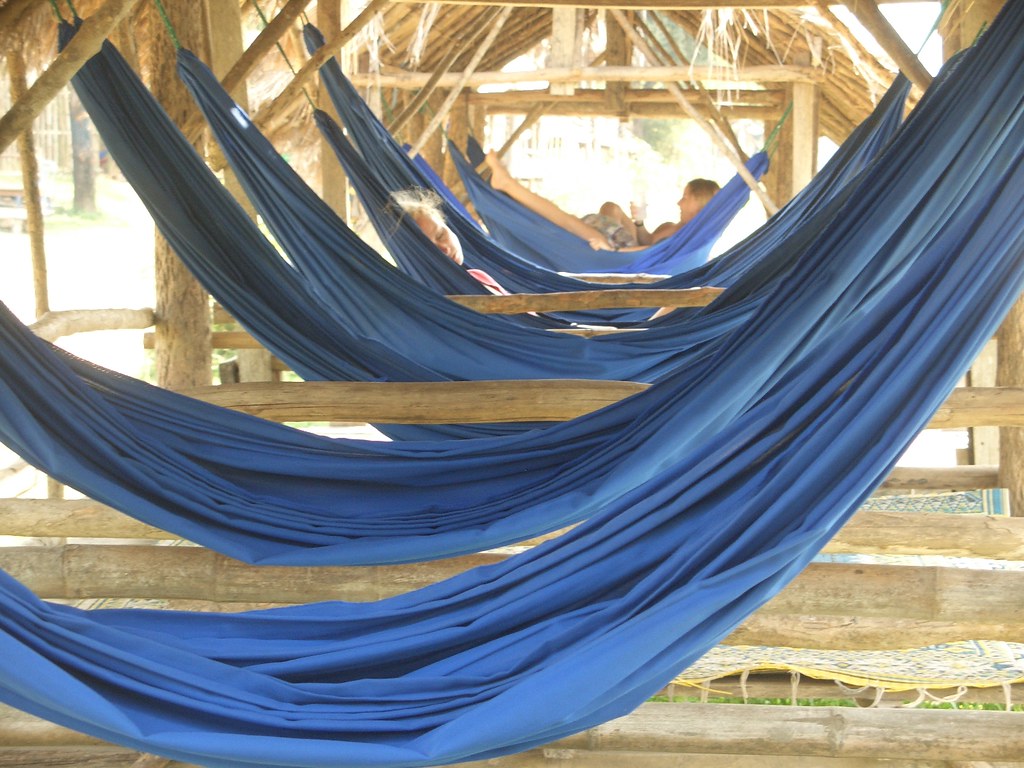
Si Phan Don (4000 Islands) for hammock time and Khone Phapheng waterfall, the Bolaven Plateau near Pakse for coffee farms and more waterfalls, and Kong Lor Cave – a 7km boat trip through a limestone cave system that's one of the more memorable things you'll do in Southeast Asia.
Tip-based walking tours haven't really taken off in Laos the way they have in Thailand – your best bet for a guided orientation is usually whatever your hostel has on offer, or a half-day tour booked once you're in town. Our Outpacker chatbot is available to help you plan and build out your itinerary to make the most of your trip.
Getting around
Compare time, comfort and cost
Compare journey time as well as price when moving through Laos.
Buses and minivans cover most routes, but roads
particularly in the north and south – are rough, winding and slow, so journey times often run longer than Google Maps suggests.
Bus and minivan
VIP buses and minivans connect all the main towns and are the cheapest way to cover distance, though minivans are cramped and driven harder on the winding mountain roads.
Train
The China-Laos railway (opened in 2021) has genuinely changed travel here – Vientiane to Luang Prabang is now around two hours by train instead of a full day on winding roads, and it's worth booking ahead in peak season as seats sell out.
Slow boat
The classic Mekong route from Huay Xai to Luang Prabang, run over two days via an overnight stop in Pakbeng.
Download offline maps, keep key booking details available without data and avoid placing an international departure immediately after a fragile overland transfer.
Culture and events
Events worth knowing about
Laos's festival calendar runs almost entirely on the Buddhist lunar calendar, so most dates shift year to year – worth checking before you build a trip around one.
A religious festival marking the retelling of the Vessantara Jataka, one of the Buddha's past lives, over three days of temple readings and processions.
A country-wide water festival, with buckets, hoses and water guns turning the streets into a free-for-all much like Songkran in Thailand.
A rain festival where villages build and launch homemade bamboo or PVC rockets skyward to ask for a good rainy season, alongside music, dancing and a fair bit of local rice whisky.
A religious festival marking the start of Buddhist Lent, when monks retreat to their monasteries for three months of study and meditation.
A religious festival marking the end of Buddhist Lent, with candlelit boat races on the Mekong and Nam Khan rivers by day, and small banana-leaf "fire boats" set adrift at night in Luang Prabang and Vientiane.
Confirm the official programme, accommodation pressure and transport changes before committing non-refundable plans.
Lao food
Discover the flavours that make Laos memorable
Lao food gets overshadowed by Thai and Vietnamese cuisine, but it's worth seeking out in its own right – earthier, herbier and less sweet than Thai food, with sticky rice as the staple instead of jasmine rice.
-
 Larbminced meat salad with herbs, lime and toasted rice powder, considered the national dish.Photo: David McKelvey / flickr, BY-NC-ND 2.0
 -
 Tam Mak HoongLao-style green papaya salad, similar to Thailand's som tam but often with fermented fish sauce, so ask if you want it milder.Photo: World Bank Photo Collection / flickr, BY-NC-ND 2.0
 -
 Khao Piak Sena warming chicken noodle soup, good for a cooler morning up north.Photo: BrandontheMandon / flickr, BY 2.0
 -
 Or Lama Luang Prabang stew with buffalo meat, herbs and a distinctive bitter wood ingredient (sakhaan) that numbs the tongue slightly.Photo: shankar s. / flickr, BY 2.0
 -
 Sin DadLao-style barbecue, cook-it-yourself over a charcoal dome at the table.Photo: Prince Roy / flickr, BY 2.0
 -
 Mok Pafish steamed in banana leaf with herbs, a classic Mekong-side dish.Photo: laofood / flickr, BY-NC 2.0
 -
 Khao Jeea legacy of French colonial rule, a crusty baguette usually filled and sold as a cheap breakfast, especially in Luang Prabang's morning market.Photo: ssour / flickr, BY 2.0
 -
 Sticky rice (khao niao)served in a woven basket, eaten by hand, and part of nearly every meal.Photo: shankar s. / flickr, BY 2.0
Night markets in Luang Prabang and Vientiane are the easiest way to try a spread of dishes in one sitting.
Visible turnover is a useful guide. Explain allergies carefully and carry a translated note when an ingredient could cause a serious reaction.
Hostels
Choose the atmosphere, not just the bed
Laos has fewer hostels than Thailand or Vietnam, and quality varies more – read recent reviews before booking rather than turning up on spec, since a few options look better online than they are in person.
Funny Riverside Backpackers
Luang Prabang, LaosProperty image from Hostelworld's official HOSCAR record.View photos and details →Mad Monkey Vang Vieng
Vang Vieng, LaosProperty image from Hostelworld's official HOSCAR record.View photos and details →Vang Vieng Chill House
Vang Vieng, LaosProperty image from Hostelworld's official HOSCAR record.View photos and details →Easy Go Hostel
Vang Vieng, LaosProperty image from Hostelworld's official HOSCAR record.View photos and details →Sanga Hostel
Pakse, LaosProperty image from Hostelworld's official HOSCAR record.View photos and details →What you need to pack
Pack for the route, not every possibility
This depends on the time of year, so also check the trip planner chatbot for anything specific to your dates, alongside the weather section above – it'll build you a kit list based on exactly where and when you're going.
Climate and clothing
Heat and humidity are the main issues for most of the year, so pack clothes that are breathable and don't hold onto smell.
- DEET mosquito spray – malaria risk is present in rural parts of Laos (unlike Thailand's tourist areas), so this matters more here – talk to a travel clinic about antimalarials too if you're heading off the main tourist trail.
- A universal travel adapter and a power bank – Laos mostly runs on Type A/B/C/E/F sockets at 230V, and power cuts aren't unusual in smaller towns.
- Run all of this through the trip planner to build your full kit based on your specific route and dates.
Rain and terrain
Most people get away fine with regular sports or gym-style shirts from home – breathable, cheap, and they do the job.
- A headlamp – genuinely useful for cave systems like Kong Lor and Nong Khiaw, and for guesthouses with patchy electricity in rural areas.
- A sarong or light scarf – doubles as a modesty cover for temples, a beach towel substitute by the Mekong, and an extra layer on long bus rides.
- One more to keep in mind: temples require covered shoulders and knees, so pack at least one modest outfit even if the rest of your kit is vest tops and shorts.
Hostels and travel days
You can pack light either way, since hostels and guesthouses in the main towns almost all offer cheap laundry, and local laundrettes are easy to find too – just build in an extra day if you need something back for an early bus.
- A dry bag – for slow boats, tubing and cave trips, keeps your phone and passport safe from an unexpected soaking.
- Motion sickness tablets – mountain roads in the north are winding, and long bus journeys can be rough going.
Activities and health
Unlike much of Southeast Asia, Laos genuinely gets cold at night in cool season, especially up north and in the mountains, so pack at least one proper warm layer if you're travelling November to February – a lot of first-timers underestimate this and end up buying a cheap fleece at a night market.
- A reusable water bottle with a filter – tap water isn't drinkable here, and this cuts down on buying plastic bottles every day.
- A basic first aid kit – plasters, rehydration sachets and something for an upset stomach.
Language
A few Lao phrases go a long way
English is spoken in tourist hubs like Luang Prabang and Vang Vieng but drops off quickly elsewhere, more so than in Thailand – a few basic phrases go a long way here.
| English | Say it in Lao | Pronunciation |
|---|---|---|
| Hello | Sabaidee | sa-bai-dee |
| Goodbye | La kon | lah-gon |
| Yes / No | Men (men) / Bo | baw |
| How much? | Thao dai | tao-dai |
| How are you? | Sabaidee bor? | sa-bai-dee-bor |
| Please | Sohm | som |
| Do you speak English? | Jao pood pasa Angkit dai bor? | jow-poot pa-sa ang-kit dai bor |
| Help, please | Suay khoy dae | soo-ay-koy-day |
| Where are you from? | Jao ma jak sai? | jow-ma-jak-sai |
| What is your name? / My name is... | Jao seu nyang? / Khoy seu... | jow-seu-nyang / koy-seu |
| Thank you | Khop chai | kop-chai |
| Use the phrases respectfully: Lao is tonal, like Thai, so the same word said with a different pitch can mean something completely different – don't stress about getting it perfect, locals are generally patient with visitors having a go. | ||
Visa requirements
Check the rule for your passport
Entry rules depend on nationality, journey and length of stay. Confirm the current rule before booking, then check it again shortly before departure.
Check your exact requirements
Use Sherpa to review entry requirements for your passport and journey. Also confirm passport validity, permitted stay, proof of onward travel and any current arrival-form requirements.
Vaccinations
Make the advice fit your route
Vaccination and health advice depends on your route, duration, medical history and activities.
Review current CDC guidance
Read the current CDC Laos traveller guidance, then discuss personal recommendations with a qualified clinician.
Arrange appropriate travel insurance and keep policy details available offline. Consider the practical risks created by climate, altitude, insects, animals, water activities and road travel on your specific route.
Safety and common scams
Standard caution, specific habits
Laos is genuinely one of the safer, more relaxed countries in Southeast Asia for solo travellers – low crime, friendly locals, and a much smaller scam culture than somewhere like Thailand or Vietnam.
Methanol-tainted alcohol
in November 2024, six tourists died and several more were hospitalised after drinking methanol-laced spirits at a hostel bar in Vang Vieng; the case is still working through the Laotian courts in 2026, and the UK government has since named Laos in its updated methanol poisoning advice. Stick to sealed, branded bottles, be wary of free-pour spirits, shots and cocktails at cheap bars, and know the warning signs (confusion, blurred or blackened vision, nausea) since onset can be delayed by hours – get to a hospital immediately if anything feels off after drinking, don't sleep it off. This isn't unique to Vang Vieng, but it's the town where it happened and where nightlife is heaviest – a sealed bottle of Beerlao is the lowest-risk option if you're unsure.
Unexploded ordnance (UXO)
Laos is the most heavily bombed country per capita in history, a legacy of the Vietnam War, and unexploded ordnance is still a real issue in rural areas, particularly around the Plain of Jars. Stick to marked paths and never touch or move any old metal object you find in a field – the COPE Visitor Centre in Vientiane explains this properly if you want the full context.
Tubing and scooter accidents
alcohol plus water plus rough terrain is a bad combination, and rented scooters on patchy roads catch out a lot of inexperienced riders. Don't drink and tube, wear a helmet on a bike, and check your travel insurance actually covers it.
Unlicensed trekking or cave guides
especially around Luang Namtha, Phongsali and Vang Vieng's cave systems. Book through your hostel or a known operator rather than whoever approaches you on the street, since safety standards on unlicensed tours vary a lot.
Bill padding
less common than in bigger party destinations, but still worth checking your tab in busier bars in Vang Vieng and Luang Prabang.
Border crossing "help"
at land crossings, particularly from Thailand, people offering to "help" with visa forms for a fee are unnecessary – the process is straightforward enough to do yourself.
None of it should put you off
Laos remains one of the calmer, friendlier places to backpack in the region, just take the alcohol and road safety points seriously rather than assuming the slower pace means lower risk.
Stay aware without letting caution take over the trip. Confirm prices, secure valuables and walk away from pressure.
Sources and feedback
Help us keep this guide useful
Travel information changes. Verify current entry, health, safety and transport guidance before booking or travelling.
If you spot anything that could be improved, corrected or updated, please use our contact page or email hello@outpacker.co.uk.
If any information is outdated or incorrect, Outpacker assumes no liability.